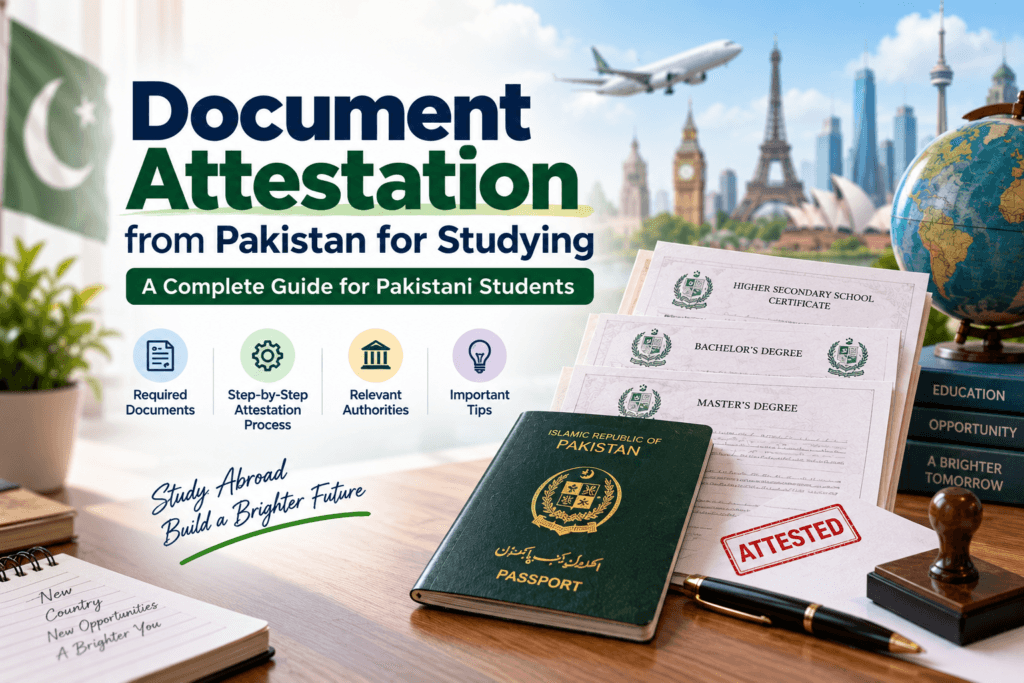
Document Attestation from Pakistan for Studying: Complete Guide for Pakistani Students
Studying abroad is a big step for many Pakistani students. It opens up opportunities but it also comes with important formal steps. One of the crucial steps is document attestation.
This process verifies that your educational and personal documents are real and can be trusted by institutions. Universities, scholarship programs, immigration offices and embassies often ask for attested documents before they approve admission or issue a student visa.
Document attestation means getting a stamp or certificate on your document. It confirms that the document was issued by a recognized authority in Pakistan and that you can use it internationally.
Depending on the type of document and where you plan to study, you may need attestation from different organizations. The main authorities involved are the Inter Boards Coordination Commission (IBCC), the Higher Education Commission (HEC), and the Ministry of Foreign Affairs (MOFA).
What Is Document Attestation?
Attestation is the verification of your documents so that they are accepted overseas. It ensures that your academic records and personal papers are genuine.
Common documents that may need attestation include:
- Matriculation and Intermediate certificates
- Diplomas
- Transcripts
- Bachelor’s and Master’s degrees
- Provisional certificates
- Equivalence certificates
- Birth certificates
- Marriage certificates
- Police character certificates, if needed
However, not every student needs attestation for every country. The requirements depend on the university, the program, the destination country and the visa process.
Some countries accept documents during initial applications and ask for attested ones later.
Main Authorities Responsible for Attestation in Pakistan
IBCC Attestation
The Inter Boards Coordination Commission (IBCC) handles secondary and higher-secondary education documents.
These include:
- Matriculation (SSC) certificates
- Intermediate (HSSC) certificates
- DAE and technical diplomas
- Mark sheets
- Other eligible certificates
Most documents from BISEs and BTEs must first be verified by the board that issued them before going to IBCC for attestation.
HEC Attestation
The Higher Education Commission (HEC) deals with higher-education documents from recognized universities and degree-awarding institutions.
This includes:
- Bachelor’s degrees
- Associate degrees
- Master’s degrees
- MS degrees
- MPhil degrees
- PhD degrees
- Academic transcripts
- Provisional certificates
- Postgraduate diplomas
- Some equivalence letters
HEC uses a system called the Degree Attestation System through its e-services portal.
MOFA Apostille
The Ministry of Foreign Affairs (MOFA) provides authentication and apostille services for documents used abroad.
After your documents have been verified or attested by IBCC or HEC, you might need MOFA attestation or an apostille. The exact steps depend on the rules of the country you’re applying to.
Documents Required for Studying Abroad
The documents you need vary based on your education level and the country where you plan to study.
For Bachelor’s applicants, common documents include:
- Matriculation and Intermediate certificates
- Result cards or mark sheets
- Passport
- CNIC or B-Form
- IBCC-attested papers where required
- MOFA attestation or apostille, if required
- English translations, depending on the university or embassy
For Master’s applicants, you will usually need:
- Bachelor’s degree
- Bachelor’s transcript
- Intermediate and Matriculation certificates
- Passport
- CNIC
- HEC-attested documents where needed
- MOFA attestation or apostille, if applicable
PhD applicants often need detailed academic records. This may include:
- Master’s and Bachelor’s degrees
- Transcripts
- Previous certificates
- Research proposal
- CV
- Recommendation letters
- Passport
- Relevant HEC or MOFA documents
Step-by-Step IBCC Attestation Process
The IBCC attestation process starts with verification from the board that issued your certificate.
You then apply through the IBCC attestation portal.
Choose how to submit:
- By appointment
- By courier
- Express service, when available
You must pay the fee and provide all required documents, such as:
- Application form
- Original certificates or mark sheets
- Board verification
- CNIC copy
- Payment receipt
- Other supporting materials
Once processed, you can receive your attested documents through the method you chose.
Step-by-Step HEC Attestation Process
HEC uses an online Degree Attestation System.
You start by creating or logging into your account on the HEC e-services portal and selecting the “Degree Attestation” option.
Then you fill out your academic information and upload clear scanned copies of your documents.
Depending on your case, you may need to provide:
- Degrees
- Transcripts
- Provisional certificates
- Equivalence letters
- Professional registration certificates
HEC may double-check your documents with the university that issued them. If something is missing or incorrect, your application could be returned for correction.
After verification and approval, HEC issues an e-Attestation Certificate that you can access via your online account.
Students should check that their name, father’s name and date of birth match across all identity and academic documents.
HEC guidelines also include notes about changes, professional qualifications, transcripts and similar cases.
MOFA Attestation, Apostille and Embassy Legalizations
After your educational documents have been verified or attested by IBCC or HEC, you might need MOFA attestation or an apostille depending on the country you’re going to.
An apostille is a form of authentication under the Hague Apostille Convention. In countries that are part of this convention, an apostille can replace long legalization procedures.
Having an apostille doesn’t guarantee that every university or immigration office will accept your document without further checks.
Some countries require embassy or consulate legalization instead.
That process usually includes:
- Issuing authority verification
- IBCC or HEC attestation
- MOFA attestation
- Embassy legalization
- Certified translation
Is MOFA Attestation Required for Every Country?
No. MOFA attestation or an apostille is not required for every country.
Requirements vary based on:
- Destination country
- University
- Degree level
- Admission stage
- Visa process
- Scholarship body
- Document type
- Translation rules
For example, some universities accept scanned copies at first and only ask for verified documents after offering admission.
In other cases, attestation becomes necessary during the visa application.
Country-Specific Requirements
Different countries have rules for document attestation.
European nations, for instance, may have rules for apostilles, embassy legalization, certified translations and recognition of academic qualifications.
In the United Kingdom, universities and visa officials may request documents or extra proof depending on the institution and the application type.
In the United States, universities may want official transcripts, sealed documents, credential evaluations or direct verification from the school.
Canadian institutions often expect official or verified academic records.
Meanwhile, universities and immigration officers in Australia and New Zealand might ask for copies or official academic documents.
Since these rules can change, students must follow the instructions from their chosen university and visa authority.
When Should Students Get Their Documents Attested?
Attestation can be needed at different points in the study-abroad journey.
Some universities request attested documents during the application phase. Others allow scanned versions at first and ask for attested ones after giving a conditional or final offer.
In some situations, attestation is needed during visa processing.
Students should carefully read their admission letter, university checklist and visa requirements before starting the attestation process.
Common Mistakes to Avoid
Students can avoid delays by avoiding these common mistakes:
- Using the wrong authority: HEC generally handles higher-education documents while IBCC deals with secondary and higher-secondary ones.
- Skipping verification: Some documents need board or university verification before attestation.
- Incorrect personal information: Names, father’s names and dates of birth must match across all documents.
- Submitting damaged or altered documents: Students should check if laminated, torn or changed documents are allowed.
- Ignoring country requirements: Apostille, MOFA attestation, embassy legalization and certified translation are not the same everywhere.
- Starting late: Verification and attestation take time and involve multiple steps.
- Using agents without checking: Always rely on official government websites and verify service providers before sending originals or paying money.
How Long Does the Attestation Process Take?
There is no fixed timeline for everyone.
The duration depends on:
- The authority
- Document type
- Verification needs
- Submission method
- Workload
- Additional legalizations
- Translation requirements
The process may include:
- Board verification
- University confirmation
- IBCC or HEC attestation
- MOFA authentication or apostille
- Embassy legalization
- Certified translation
- Courier delivery
Students should begin early to avoid last-minute problems before their university or visa deadline.
Final Checklist for Pakistani Students
Before submitting your documents, make sure you:
- Check the university’s document list.
- Confirm when attestation is needed.
- Verify Matric and Intermediate documents if required.
- Double-check transcript details with your university.
- Apply for IBCC attestation for school and college-level documents.
- Apply for HEC attestation for university-level documents.
- Find out if MOFA attestation or an apostille is required.
- Check whether embassy legalization is needed.
- Arrange certified translations if necessary.
- Make sure names and dates of birth are consistent across all documents.
- Keep copies of original documents.
- Save payment receipts and application tracking numbers.
- Start the process before your admission or visa deadline.
Conclusion
Document attestation is a part of studying abroad for Pakistani students. The exact process depends on the type of document, your level, where you are going, what the university requires and the visa process.
Students should first find out which authority is responsible for their documents, complete any board or university verification and then go through IBCC, HEC, MOFA, and apostille or embassy legalization as needed.
Importantly, students should always follow the latest official guidelines instead of assuming one country’s rules apply to another.
Starting the process early and carefully checking every requirement can help students avoid delays. It makes sure that their educational documents are ready when needed.
This careful approach saves time and reduces stress later on. Students who plan ahead have a better chance of getting everything in order without last-minute problems.